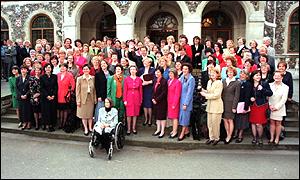
Is it really only 80 years?

As Ros and Jennie have already noted, it is 90 years ago today that women got the vote. 80 years since they got the vote on the same terms as men and 50 years since they were allowed to enter the House of Lords.

And, although all is technically equal on the legal front, we are still having to loosen, finger by finger, the grip that men have on power and money. We have just 19% of our MPs female, even less running our top companies and the pay gap, well, it's still the pay gap and interestingly (or if you're me, bloody annoyingly) gets wider the higher up the career ladder women go! I reckon, that we're about 20% down the road to equality; you know, real equality, in how we live our lives, as opposed to equality in the eyes of the law.

Women's unpaid labour is still not included in national accounts, with all the implications for public policy that that entails, rape conviction as a proportion of reported rapes is frightenly low and I don't seem to be able to walk down the road or get on a bus without having a highly sexualised image of a women presented to me at every opportunity. My favourite one to hate at the moment is one advertising a programme called 'Skins'; I really enjoy having to look at that at the bustop surrounded by primary school kids.

There's an excellent article in the Guardian about it where Katherine Rake, the Director of The Fawcett Society.

It's a wide ranging interview looking back, as well as forward, but for me she really hits the nail on the head for me when she says:

"We are only half way through the revolution: there has been a huge change in women's lives but very little in men's. We have got to look at what happens in men's lives in future, in terms of a fairer division of labour and getting the benefits and costs of that."

Such completion of the revolution means wading into the private sphere to challenge the very way most of us live our lives, but Rake remains unapologetic. "There has to be a day that happens. This is very much a part of [Fawcett's] heritage. Unless you talk about changing the rules, about social transformation, the fundamental rules don't change and you are not going to be offering equality for women.

"We have done as much as we can levering women into a system designed by men for men. Now we have to work for a society where the rules are fitted for everybody."

Don't worry! I too, the good liberal that I am, get nervous when people talk about wading into the private sphere, but she has got a point.

To be honest, I think this is what we've been trying to do in the Lib Dems for too long; we have been focussing on getting women to change and to go on all sorts of training so we can play the selection game the same way the guys do.

When we get our heads around the fact that diversity is not about looking different on the outside but, in fact, about doing things differently and that it's possible to believe in liberalism but approach the practice of politics differently, we will start to make some progress on diversity.

And changing the way we do things (the rules) means everyone, including men and I think that will make politics and liberal democrat politics, in particular, better for all of us, not just women! Hooray!

Getting liberal about diversity

Once again, the debate about diversity has come up.

Once again, the old chestnut of being ‘representative’ versus being ‘the best for the job’ is hauled out again.

Too many Lib Dems just don’t get why diversity is so important. Too many don’t see the benefits that diversity brings us. There is a lack of diversity at every level of the party and too often the only response is hand wringing.

Let’s be clear. Recognising diversity is not just about looking more representative of Britain. That, of course, would be tokenism.

Nor is it about making trying to make women and ethnic minorities (or anyone else) feel better.

Diversity is vital, because to have a different sex, colour or ethnicity to the majority of the establishment is to have a different experience of life than those who are from, or look like, the rest of the establishment.

That is especially relevant in the interpretation of the law and here I think Martin Gill is oversimplifying things when he talks of High court Judges merely applying the law.

Yes, I know the way you look shouldn’t matter. Like Martin Luther King, I’m looking forward to a time when it doesn’t matter what colour we are but we are very, very far from there now.

So, let’s be honest. Right now, society treats people differently depending on the way that they look, their sex, the colour of their skin, hair, eyes, bust, whether they are tall or short, overweight or slim. I can do something about most of those things, I can change my hair colour, even wear high heels to look taller but I don’t want to change my sex and I can’t change the colour of my skin.

Society treats women differently from men; it also treats people differently depending on the colour of their skin and therefore women and ethnic minorities will have a fundamentally different experience of life. Not necessarily worse or better but different. This leads to different approaches to life, different perceptions of opportunities and different understandings of how the world works, what is best and what is desirable.

It is that understanding that is missing from our elected representatives, the judiciary and, indeed, the Liberal Democrats.

However much a person tries to understand and empathise, there will be some areas where they are not even conscious of difference; they are not conscious that other people may have completely different perceptions or understandings of how the world works.

It works all ways; I am constantly amazed, surprised and brought up short at the assumptions and approach to life of the average man, let along the average white, upper class, privately educated man. I can’t believe, given that the dominant mores in society are those of that upper class, male establishment that they would find it any easier to put themselves in my boots than I do to put myself in theirs.

We need diversity in our public life because we are currently having our laws created, interpreted and applied by a very narrow band of society who have a very narrow, privileged experience of the world.

As long as we let it go on we are shutting out women and ethnic minorities and ignoring their legitimate needs as members of our polity and our society. To put it plainly, if we don’t have diversity then ours laws and their implementation will not be as good as they could be; they will not be the best laws for the job.

So, tell me: what is “liberal” about that?

We attempt to be blind to a person’s diversity, either because we are worried that unconscious prejudices will lead to it being ‘held against them’ or because we are trying to get the ‘best person’ for the job. If everyone that does the job is the same, if they are only from one part of society, then the last few to be recruited are not adding anything to that group’s understanding of the world: how can they be the best person for the job?

We should be celebrating and searching out candidates who add to the diversity of the group into which they are being recruited not because of the colour of their skin or their sex but because of their diverse experience of life!

That richer, more diverse experience will lead to legislation and judgements that take account of the myriad of different experiences of what it is to be a human being. All of us, whether we are part of the establishment or not will benefit from this in ways that we cannot yet imagine.

Perhaps one day, how we look will make no difference to the way society treats us; perhaps all that will matter is the content of our character. In order for us to get closer to that dream we will need to make changes at the top. We will need to ensure that our leaders are diverse because without that the change so desperately need will barely progress as long as those with the power to create, interpret and apply our laws come from just that one group.

Getting better at catching the rule breakers…

What Derek Conway did, in defrauding the tax payer, was wrong (obviously); he broke the rules but there is no need to change the rules as a result.


We don’t need to ban politician’s families from working for them…indeed it is one of the few areas where the valuable contribution that spouses often make to the careers of ambitious people is actually given a value. If someone is doing the work, they should be paid for it…it doesn’t and shouldn’t actually matter what their relationship to the employer is.

If someone breaks the rules, the fault will be down to their dishonesty and a lack of proper application and scrutiny of those responsible for enforcing the rules.

But the current media reaction: 'the rules must change!' happens all the time; a rule is broken, we are all aghast and then there are calls for the rules to be changed! Why? The rule itself works; it is its application that wasn’t working. But then changing a rule is easier and cheaper for those in charge then actually making existing rules and legislation work.

It is a particular disease of the Labour government but we in the Liberal Democrats are just as bad. When a number of local parties were struggling under the weight of potential candidates recruiting ‘phoney members’ to skew the votes towards them in selections instead of getting the returning officers, the local party and membership services to enforce rules that were already in place1 to deal with this phenomenon, we banned new members from voting in parliamentary selections for the first year of their membership. This, in the case of the recent list elections in London disenfranchised about 25% of the membership from voting. So much for our much vaunted one member, one vote!

Creating new rules instead of enforcing ones that are already there is at best sticking plaster and at worst throwing the baby out with the bath water. Just like disenfranchising a quarter of our membership, banning family members from working for MPs would punish those who work twice as hard as a non family members and serve their community as much as their spouse does.

1That is, the requirement on local parties to ‘agree’ to new members – which they can only do if membership services send them the details of their new members in time.

Increasing voter turnout the democratic way....

This really interesting posting from a Clinton activist (thanks to Duncan for having the feed on his website) goes to prove that the most exciting thing about this Us nomination race is the impact that the diversity of the candidates is having on ‘hard to reach’ or ‘never reached before’ voters!

According to NewHampster out of the 10,000 votes polled where she was campaigning that day 1,000 were registrations on the day…and from her experience of being on the ground these were mainly women. Not women who had switched from Clinton to Obama and back again at the first sight of emotion but women who had not intended up until that point to vote.

She also describes the Obama crowd that came in to vote around midday as looking like “the line for a rock concert”. Would that any polling station in the UK ever had a line, let alone one that looked like that for a rock concert!!

If this isn’t a lesson for all those concerned about voter apathy not to realise how important diversity is then I don’t know what is! I am finding it all just so exciting!

Diversity isn’t just a ‘good thing’ or the ‘right’ thing to do - it will get us more votes, more councillors, more MPs, more AMs, MSPs and MEPs!

How are we going to attract more women and ethnic minorities to join us and ensure that as a party we reflect the people that we seek to represent? So that in future elections in the UK we reach the thousands of young men and women who are currently don’t see the point of voting? And crucially how are we going change ourselves to attract a more diverse group of people?

Women come out for Hillary!

So, it would seem, from a quick review of what's being said, that Hillary's win in the New Hampshire primaries is as a result of women coming out for her in the last few days. This is confirmation that in politics gender certainly matters.

And once again, I ask myself in a country where women make up 52% of the population why we don't take more electoral advantage of those women who do put themselves up for a selection; particularly in target, by election and vacated held seats. As Lib Dems we may not think the gender of the candidate relevant but it looks like voters do. Even in the UK there is a 2% increase in female turnout if there is a female candidate (and a neutral impact on male voters); 2%, well, that can make quite a difference at times, can't it?

You see, although I do think that diversity is 'a good thing' in it's own right, I do find the fact that diversity helps win votes an even more compelling argument for having more of it!

Lynne in her blog post this morning can almost be heard sighing over how far equality has to go if male BME MPs are having to defend their choice of Hillary vs. Barack lest they should be seen as disloyal. Lynne looks forward to a time when colour or gender doesn't matter when choosing a candidate, when all that matters is whether they are the best.

Well, I think that's wishful thinking. Firstly, because I believe that for the vast majority of voters the decision of who to vote for is intuitive and a response to an engaging political narrative or (and this may be the same thing) an identification with the candidate. It is rarely a rational assessment of the pros and cons of the candidates skills set and policies, so hankered after by us political activists.

Secondly, even if voting wasn't such an intuitive matter that still leaves us with the problem in defining best; this is entirely subjective. It may be, if I had a vote in the US elections, best for me that I vote for a woman who has experienced all sorts of below the radar prejudice herself and is conscience of all the invisible, non legal hurdles that women have to climb even to compete in the workplace, for example. That would be quite logical for me, I guess.

And to prove my point, If I did have a vote in these elections I would be voting for Obama...for the intuitive reasons outlined above; I have completely fallen for his political narrative. That doesn’t mean though, I would be outraged if Hillary got the nomination.

However, what is most exciting is how riveting the democratic nomination process is this year!

As someone who is much more interested in the issues that politics has sway over rather than the game itself, this is the first time that US politics has captured my imagination. And it would seem from the increased turnout that it has captured the imagination of many voters in the US who previously couldn't give a fig for primaries!

It surely can't be that the idea that, if the Democrats win, they will either be putting a women or a black man into The White House for the first time, has nothing to do with it? Imagine if we had such diversity at the top of politics in the UK, might not that lead to a resurgence of interest in politics that we Lib Dems could capitalise on?

What sort of people do we want to be our candidates?

"We could avoid so many of these problems if we made it clear to all people who join us that they are expected to prove themselves by years of hard work on the ground before being put into positions of responsibility".
So says Martin Land in response to Cllr Faraz Bhatti’s defection to the Tories in the North West.

I don’t want to get into a particular discussion here about diversity, representation or even defections here but instead question Martin’s assertion that anybody wanting to be an elected representative should have to undertake ‘years of hard work’, (by which I presume he means focus delivery), before being allowed into a ‘position of responsibility’; it doesn’t seem clear whether positions of responsibility refers only to being a candidate / elected representative or does it also include being an organiser or party treasurer or the person who organises the local fund raising events?

But it got me thinking; is that what we really require of our candidates? That they are the winners of a humungous ‘I’ve delivered the most focuses ever’ contest? It seems to me that we required candidates even in 2nd tier seats (or whatever they’re now called) that they give up everything else in their life, sacrifice their career, their family and time with their friends in order to just get selected for the seat. In the last election one of the Tory websites estimated that it costs a candidate an average of £40,000 to stand for election in a non-target seat.

I am worried that we are making being a candidate such a frightful experience, such a hair shirt, that we are putting off all sorts of really good people. Whether they are male, female, white or minority ethnic, people who are talented will inevitably tend to have more than one choice of how they make some difference to their community and their country.

Over the last couple of years I’ve seen a number of people, who would make excellent candidates and even better MPs, take the decision that the sacrifices that we Lib Dems require of them is not worth the eventual reward. We expect our candidates to be working at full tilt from one year to the next perhaps over 2 or 3 electoral cycles – that's 12 years out of someone’s life! Or instead they make a decision to go for list elections rather than first past the post, as those place less focus on the individual and are therefore easier to sustain over a period of time.

Many, many of us enter politics to change the world and talented people will be offered many routes to changing the world; being a Lib Dem elected representative will only be one of them. It will not necessarily be a lack of determination or character that makes them turn away from us and choose to do something else with their life. It might be a view that they can be more effective somewhere else. And then they are gone, and we’ve lost them.

If you make being a candidate a function of time served, or focuses delivered or postcode then what you will get it is focus deliver who has been around the longest, in that ward and who has nothing better to do. There is a difference between being the best person for the job and being the one who wants it most (although it is wonderful when those two things coincide, which happily they often do).

I do think it is important to be committed to a cause and time served of course indicates a commitment. But we need to get our heads around that we don’t have hordes of highly qualified people queuing up to be candidates; the only place that happens is the target constituencies and wards. We need to really think about what are the most vital qualities of our candidates. Experience too is important, but experience can be gained elsewhere and transferred; in fact I think that is a good and very healthy thing.

I also think we need to do some work around the role of agent and organiser; Mark Valladares has already made a plea for creating more than one ‘career path’ in the party; in fact in fact, if you have a super duper, experienced and organised agent then to have those qualities repeated in your candidate is unnecessary; I think this is very much the model used for by elections. Or perhaps (tongue placed firmly in cheek) we could think of people running on double tickets of Agent & Candidates!!! (!!??!!) There's much to be said for making 'stars' out of agents as well as our candidates.

Good, talented, hardworking, committed people will have a number of choices; it is unlikely that the Lib Dems will be the only people that have spotted their talent. Their bosses, other voluntary organisations, their friends and families will all be offering them opportunities to make the contribution to society that they seek. We should not fool ourselves into thinking that they need us more than we need them.

Campaign for Gender Balance Blog Awards & James' Meme

James very kindly asked me to complete his meme just before the Christmas Holidays; I'm back, so here is my answer, now updated with favourite non Lib Dem female bloggers!!!

Favourite Blogs:

Urgh…there’s just too many that I like. But here’s my three!

Charlotte Gore: I am deeply interested in her chosen topic of political narrative and love the fact that she blogs to engage in good natured discussion and not just to bark her opinions at the world; quite a skill! She has excellent insight and judgment and isn’t scared to leap from the logical to the intuitive and back again!

Blunt & Disorderly: A bit intermittent with the posts but I really like the fact that she’s clear that feminism isn’t a dirty word and she blogs on some really interesting topics which are not picked up elsewhere on the Lib Dem blogosphere. She’s tipped me off on some very interesting articles which have got me thinking and blogging and for that I am very grateful.

Lynne Featherstone: We share an interest in home affairs and the horrors of the DNA database but one thing I’ve always enjoyed about Lynne’s blog is how it demystifies the process of being an MP and is a great role model to women thinking that formal politics isn’t for women!

Best Blog Posting:

Jo Anglezarke
with this for understanding that to open a debate rather than giving a lecture makes the blogosphere such a great place to be!

Alix Mortimer, has many, many good posts to choose from but this one was a particularly fun and imaginative!! But then, maybe I am just really boring too……

Linda Jack has many postings of this type and I am glad that she keeps banging on about it.

Favourite non lib Dem Female Bloggers

Pandemian, Dulwich Mum (just how tongue in cheek, I don't know...I suspect not at all!!) and of course, Philobiblon, who write about all sorts of interesting things and is also the founder of the Carnival of Feminists (which is a feminst equivilant of Britblog Round Up) and is fantastic, but not technically a blog so can't be nominated.

Women I’d like to see blog but don’t:

My good friend Lindsey Brummitt, because she’s smart and witty but doesn’t believe me when I tell her!

If Mariella Frostrup has a blog then I’m unaware of it but I really enjoy her insights on Openbook.

I’m not sure if this is allowed but I would have loved it is Linda Smith would have written a fantastic blog! And she was a humanist!

I will update with non Lib Dem female bloggers that I like…there’s far, far too many to choose from!

Women Bloggers: not weaker, just different...

Jonathan from Liberal England is worried that women’s blogging awards will just serve to position women as the weaker sex. But, is offering a platform for an underrepresented group to get increased profile really such a minefield? Are women Lib Dem bloggers (and beyond) really so in danger of being patronised and undermined? Surely, the good female bloggers such as Alix or Charlotte, to name just a couple, don’t need a special award…surely they can compete in the full blown Booker of Lib Dem Blog awards?

I think Jonathan is worrying unnecessarily; I think it’s a great idea and I don’t feel in the slightest bit patronised or undermined. The Lib Dem blogosphere, at least, is very male in terms of gender and in terms of sex. It can be a pretty macho, testosterone fuelled place in terms of those writing. It’s hard to know what the readership is in terms of sex but I would guess that it mirrors the proportions of those who write.

This means, inevitably, even with the best will in the world, the subjects that get written about most are the priorities of those men writing from a male perspective. This is not to say that many, many of the things that are written about don’t interest women readers, they do. However, some subjects are not written about as much or prioritised as much.

It’s one of the reasons that I started writing my own blog; there were things that were interesting to me that rarely got mentioned on Lib Dem blogs and still not get the attention I would like them to have. Now some of that may be down to the quality or frequency of my writing but I think some of it is definitely that often I will choose ‘feminist’ topics to blog on.

What I do notice, from Lib Dem Voice’s weekly round up of blogs is that the posts that get the highest number of hits are usually focussing either on Westminster gossip or internal party politics.

Jennie , is quite right when she points out that the blogosphere is full of women bloggers and that their blogs tend not to be so overtly or acutely political. And I would say that was a fair reflection of many women’s approach to life…politics is part of it but not everything. Jonathan also references the excellent Philobiblon who not only hosts the Brit Blog Round Up but is also the founder of Carnival of Feminists which is proscribed reading for me, even if I don’t agree with every contributor!

However, it seems to me that there is a space for political female bloggers in the Lib Dem Blogosphere but it’s not currently very big. If we need these awards to elbow our way into higher profile, particularly with women who perhaps don’t read any of our blogs at the moment then I think they are a good thing!

Right, I’m off to Selfridges for the last time before Christmas…I wouldn’t be blogging now but for the fact that I broke my computer a week ago and a suddenly opportunity came by to access my blog and post something, rather than just read and comment on others! Who knows when I will be back; no doubt when my Sony comes back from laptop hospital after Christmas but maybe, hopefully before!

What's all this cultural relativism about then?

Gillian Gibbons is freed and the Sudanese Government hasn’t made any contribution to the idea that Islam is a peaceful religion and that followers of Islam are not all fanatics ready to take umbrage at the slightest slur to their religion.

In the UK, it has been pleasing to see that the majority of people commenting, irrespective of their religion or lack thereof have been appalled by the actions of the Sudanese government; at all points there were choices both around the interpretation of the offence and the law and at every point the Sudanese establishment chose the most extreme action.

There has been though, throughout this, whether on BBC comments, Blogs or Any Answers a significant minority of people who have suggested that Gillian Gibbons only had herself to blame, as she should have known the law. She was in fact naive.

I think there is an enormous difference between causing offence and invoking the displeasure or irritation of whoever has been offending (and therefore being marked out as someone you wouldn’t want to spend time with) and being put in prison or lashed for it. The naming of a teddy bear does no physical harm to anybody.

I’m pretty much an atheist and don’t have much time for religion, but I’ve no real interest in going around deliberately causing offence to other people for the sake of it; I think that’s a waste of time, energy and just not very nice. But I believe passionately in free speech and therefore in my right to cause offence without being punished by a state for it.

I’ll give you an example from my own experience where, as an acutely left handed person, I am in danger of causing offence every time I go to the Middle East and without realising it pick up my bread to scoop up some food with my left hand. This is really, really bad table manners; I mean I might as well start picking my nose at the table (in fact, it’s much, much worse than that…but I don’t want to put you off your dinner). Should I be lashed or sent to prison because I have, with no malicious intention broken, in Meral Ece’s words, ‘a few of the cultural 'rules' we learn to live with’,? Sure, don’t invite me to dinner again, suggest I use a knife and fork rather than my hand (as people have) or just tell me plainly not to use my left hand (as an ex-fiancé’s brother once decreed), explain to me the error of my ways, but please don’t send me to prison for it!

Another analogy: this time looking the young woman the other week in Saudi Arabia who was sentenced to 200 lashes for being in the company of a man she wasn’t related to ahead of being gang raped. Now, she is a Saudi, not just a visiting teacher, she surely knew the law? Do we all then sit back, fold our hands on our laps and say: ‘Well, she knew what the law was…how naïve of her!’. No, we don’t, because we know that her punishment under that law is an infringement of human rights, just as the response to Gillian Gibbons was by no means reasonable or just a harmless cultural difference. I make this point not out of a lack of respect for the rule of law in a given country but out of my greater respect for human rights.

Perhaps if Gillian Gibbons had got the lashings she was at risk of, instead of a very short prison sentence and pardon, then not as many people would have found it so easy to slip back into an ‘oh, well, it’s different there’ mentality; but remember it’s not just western primary school teachers that have no freedom of speech or apostasy in Sudan, is it?

Lots of people, from all religions or none know and understand this, I am sure, but lets not forget that human rights are for everybody, absolute and not subject to cultural relativism.

What should MPs look like?

Is it really just this?

There has been a flurry of interesting posts on Lib Dem Blogs gender equality in blogging, in the Lib Dems and in general over the past few days; it feels like it has been a bit of a breakthrough for women bloggers, there’s been a definite surge of confidence.

‘Wimmins’ stuff isn’t massively popular on Lib Dem Blogs and so it was nice to see Alix’s posting on Positive Discrimination getting nigh on 40 comments and opening a lot of discussion. I found it really heartening to hear a wide variety of opinions and some of them even chiming superbly with my own. I was especially struck by Linda Jack’s question on who defines the ‘best’ when it comes to candidates’ she says:

“Democracy has its downsides - if a man gets a job for which a woman is better qualified she has redress in law, if, because of the subconscious prejudices of an electorate that sees an MP as a white middle class well educated man, as better than a more qualified woman, she has no redress. This is the difficulty of using the word best.”
I would argue that the problem is less with the electorate, who actually come out and vote more if there is a woman candidate but the ‘selectorate’…the people choosing the candidate in the first place. I don’t think they realise what an electoral asset women are and are unnecessarily small ‘c’ conservative on behalf of the voters in short I think they read voters wrong.

I also think that all the political parties are conservative, when they’ve finally plucked up the courage to select a woman in a winnable seat around how she should look.

When going to Fawcett Society ‘Do’s’, I find myself more often or not talking to women from the Labour Party, as Lib Dem and Tory female activists are pretty thin on the ground at such events. It is fascinating to hear about a completely different cultural approach to gender and I’m not just talking all women shortlists. However, one thing that doesn’t seem to be different is the requirement for female candidates to look a certain way. In the Labour party they all get sent to Barbara Follett for a makeover…it’s known as ‘folletting’.

And so you end up with something akin to this…better…but still not really representative, is it?

The other week I met Johanna Sumuvuori MP, whom I found completely inspiring and engaging and who had definitely never, ever been folletted!! Obviously, she had a super name; in fact, reading her CV was a bit of a masterclass in visualisation – ‘Johanna sits on this committee in parliament, Johanna is the chair of that committee’; I’ve saved it to waft in front of myself in moments of weakness, in the manner of smelling salts.

But more importantly as I looked at her and listened to her speak I couldn’t help but think how much I identified with her. I find it difficult to explain completely but I looked at her and thought to myself that nobody had ever taken it upon them selves to tell that if she wanted to succeed she would need to dress differently, iron out any individuality and for goodness sake don’t do anything to bring attention to the fact you are a woman!!

Somewhere along the lines to Finnish parties have worked out that you can be representative, you can scrutinise, you can sit on and chair committee whilst looking like a young woman in your thirties; any young woman.

Finland use a list system and PR allows one to focus less on the individual and more on the party; no doubt if it were a first past the post system there would be more pressure on individual candidates to conform to a stereotype that is acceptable to the media and party system.

And obviously, I’m not suggesting that the 9 (is it really only 9?) women Liberal Democrat MPs are lacking in individuality or criticising their personal style or anything like that; they dress like business women, like I do. Our female MPs, PPCs and business women like myself do this because not to would undermine our credibility. In fact, even when I’m working at a client’s who have a dress down policy, I go in wearing a suit, just to make sure. But, I admit I was intrigued by Johanna, her style (which would be much like mine, if I was left to my own devices) and her ability to be all this and still have power! Frankly I was pretty envious and briefly wished my mother had had the foresight to school me in Finnish.

I thought to myself how wonderful it would be to be able to just look myself when campaigning to be selected instead of having to dress in a particular way to try and prove that I have the ability to be a good candidate or MP.

But, I also thought what a fantastic role model Johanna is to young women in Finland, who must surely recognize themselves in her and feel far more confident about their ability and right to go forward and represent their party and fellow citizens without losing part of their own individuality in the process. And of course, vote for her…..because I am quite sure that she is an electoral asset.

Back to Home Back to Top Jo Christie-Smith. Theme ligneous by pure-essence.net. Bloggerized by Chica Blogger.